
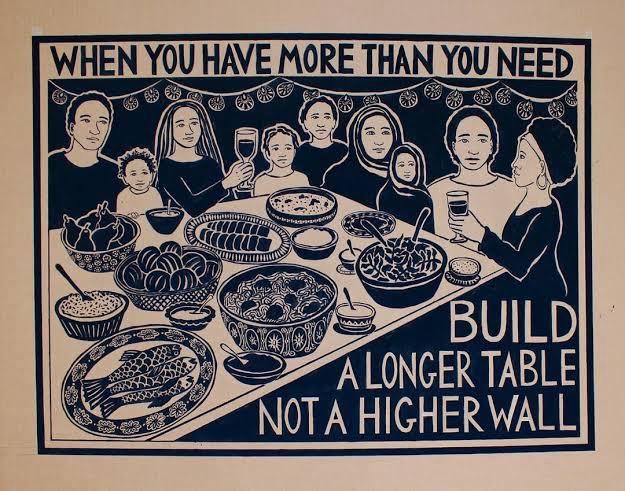
What would it look like to build a longer table in our community? What walls need to come down for this to happen? What attitudes, customs, and practices need reframing so that the table can be longer?
One of the ways I would like to draw in on, in a bid to invite YOU (my friends: my chosen family, acquaintances, those unknown to me and vice versa) to join me and participate in building a longer table, is by first highlighting the importance of the adoption and uptake of the “Hand Up” approach to EMPOWERMENT of the less fortunate in society.
Hand up, not handout
Hand up is the “nicer and legitimate cousin” to “handout”, which more people are familiar with, and which is associated with the offering of immediate, temporary relief (like giving away free cash, food, or clothes) that solves a crisis but does not fix the underlying, root problem.
The core philosophy of “hand up” aligns perfectly with the famous proverb: “Give a man a fish and you feed him for a day; teach a man to fish.”
Depending on your upbringing, your religious background, or whatever school of thought you come from, I’m willing to bet that this philosophy isn’t entirely new or unique or abstract to most of us who are privileged to call Karen (or wherever your beautiful ward is) our home. Many of us have been blessed to have enjoyed an upbringing that not only has exposed us to, but allowed us to access and experience quality education, healthcare and other various experiences (that are far from being considered basic needs). Whether the achievement was through our own hard work, or a head start provided by our parents or grandparents, there’s a lot to be thankful for.
Intent matters: the reason behind my motivation
Poverty acts as the ultimate enemy of progress by creating vicious cycles that stifle both individual potential and societal growth. It highlights a socioeconomic imbalance where a society prioritizes private affluence while essential public goods crumble.
It denies people access to quality education, healthcare, and financial stability, forcing communities to focus purely on daily survival rather than long-term innovation and development.
And unfortunately, in this day and age, the lack of support for collective social change (low key) sends an implicit message of support for the present social order, in effect legitimizing the continued discrimination against the disadvantaged in-group and resulting in the perpetuation of their disadvantaged status.
“What the poor need isn’t charity but capital, not social workers but co-workers.”
Clarence Jordan (Theologian)Sacred service or paying it forward?
Possessing spiritual knowledge is not enough; true happiness and divine blessing come from actively applying that knowledge through humble service and love for others.
“Maintain justice and do what is right, for my salvation is close at hand and my righteousness will soon be revealed.”
Isaiah 56:1 (NIV)Inconvenience as the price of building real community
There are families and the working poor who struggle with food, clothing, shelter and comfort. Just because someone has a home doesn’t mean that person is not in need of a helping hand. By embedding moral purpose into economic action, societies preserve the trust, stability, and long-term orientation without which markets cannot endure.
Only by re-embedding economic life within a moral order that protects the ordinary citizen, strengthens justice, and nurtures civic empathy can markets generate prosperity that is both widely shared and ecologically resilient. When ordinary citizens can reasonably aspire to comfort, education, and participation in modern life, horizons expand.
Breaking the cycle
Overcoming this barrier requires the adoption of various strategies, but in this article I’m focussing on one: my invitation to take part in various community projects that lend a “Hand up”.
And helping is easier than you think. You don’t have to donate a huge amount of money or give away a chunk of your possessions — unless you want to. You can, in your own way, find ways and means to relieve suffering, foster self-reliance and provide opportunities to be of service to others, whether independently or by choosing to partner with aspiring leaders like myself.
Together we can collaborate and participate in projects and initiatives that positively impact the lives of those who directly or indirectly provide value to our lives through their service — for example our nannies, house managers, gardeners, bottle collectors, roadside sellers, “small” fundis: tailors, cobblers, your favourite nduthi guy — especially those who diligently come from neighbouring areas seeking work and other opportunities from us. Let’s put into play: The REAL bottom 🎤 approach 😏 — for the people, by the people.
Now that we’re here…
You can also help empower me as an individual by accepting my request to look through the 3 different documents I’ve worked on — for ME to serve YOU better, if given the chance to:
My Political Manifesto
Get to know about my motivation, my vision, how I intend to fulfill my mission, and why I think we could benefit from voting for an aspiring leader like myself.
Read the ManifestoProposal for Collaboration
A proposal for collaboration with anyone and everyone willing to undertake community projects. Loads of exciting, out-of-the-box ideas — get in touch, let’s lock in!
Get In Touch“Know My Voters” Survey
Because why would I guess when you can tell me? 🤷🏽♀️ I want to use real data to solve real problems — not imagined ones. I’m aiming for a minimum of 2,000 entries. Am I crazy to think it can be done? 👀👀 If you tell a friend to tell a friend, I’m sure it can be done 🤝🏽
Take the SurveyOther concepts
- Social change
- Alterations in societal structures and norms that occur beyond individual control, impacting communities, organizations, and institutions, often through collective action and empowerment aimed at improving quality of life and social justice.
- Social transformation
- Profound and systemic changes in societal structures, values, and institutions, driven by economic, political, technological, or cultural shifts. It reshapes power dynamics, social relations, and opportunities, influencing inclusion, equity, and resilience.
References
- ScienceDirect. Social change — Economics, Econometrics and Finance.
- UNESCO. Social transformation.
Pull up a chair. Then help us add another.
The table gets longer one neighbour at a time. Partner with a different kind of politics for Karen Ward.
Get Involved